
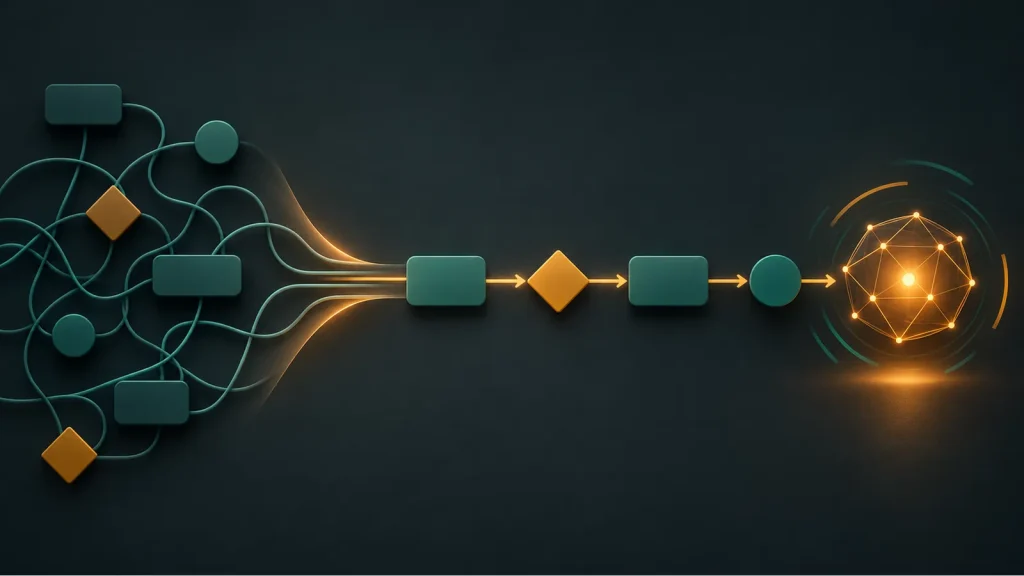
Begin with an everyday problem
“We want to use AI” is not yet an operational objective. Identify a task that consumes time or is prone to errors, such as sorting enquiries, drafting responses or collecting information for a report.
Describe where the inputs come from, who makes decisions and what an acceptable output looks like. If team members disagree about how the task should work, resolve that uncertainty before automating it.
Organise the necessary data
If customer statuses are recorded in scattered files under inconsistent names, an automated report may also give an incomplete picture. Shared field definitions, update responsibilities and appropriate access are part of preparation.
Use only the data the task requires. Before entering customer information, review the selected tool’s access and processing arrangements. A pilot can use synthetic or de-identified examples.
Separate a suggested output from a final decision
A tool can be tested for drafting responses, while the responsible person checks specifications, prices and commitments. Fluent, well-formatted output does not establish factual accuracy.
Define a route for human review when a case is unclear. The process should allow uncertain requests to be paused rather than generate a definitive answer simply to complete the workflow.
Evaluate a limited pilot
Before expanding, test both routine cases and exceptions. Compare completion time, correction requirements and error types with the previous method. Human review and ongoing maintenance are part of the actual implementation cost.
Start by documenting five things: the problem, input data, review owner, acceptance criteria and a manual fallback. Then decide which tool fits the task.
Talk to ZISA about defining your requirements and designing a digital workflow suited to your business. Start a partnership (Persian)